
From Data Fabric to Trusted AI: Why OWL/RDF and Formal Ontology Matter
Organizations evaluating modern data architectures often ask a straightforward question:
“Why adopt an OWL/RDF approach instead of relying on a Data Fabric such as Acme Fabric?”
It is the right question, but it often leads to the wrong comparison.
This is not a choice between competing technologies. It is a question of what problem you are solving: managing data, or enabling trusted, decision-ready intelligence.
Data Fabric Is About Data. Ontology Is About Meaning.
Data Fabrics have become a powerful and popular approach for integrating, organizing, and accessing data across complex environments. They unify pipelines, analytics, and storage into a cohesive platform, making it easier to connect systems and deliver insights at scale.
For many use cases such as dashboards, reporting, and operational visibility, this capability is both effective and sufficient.
But Data Fabrics operate primarily at the level of data movement and structure. They answer questions like:
Where is the data?
How do I access it?
How do I integrate it?
They do not answer the more critical question:
What does the data actually mean?
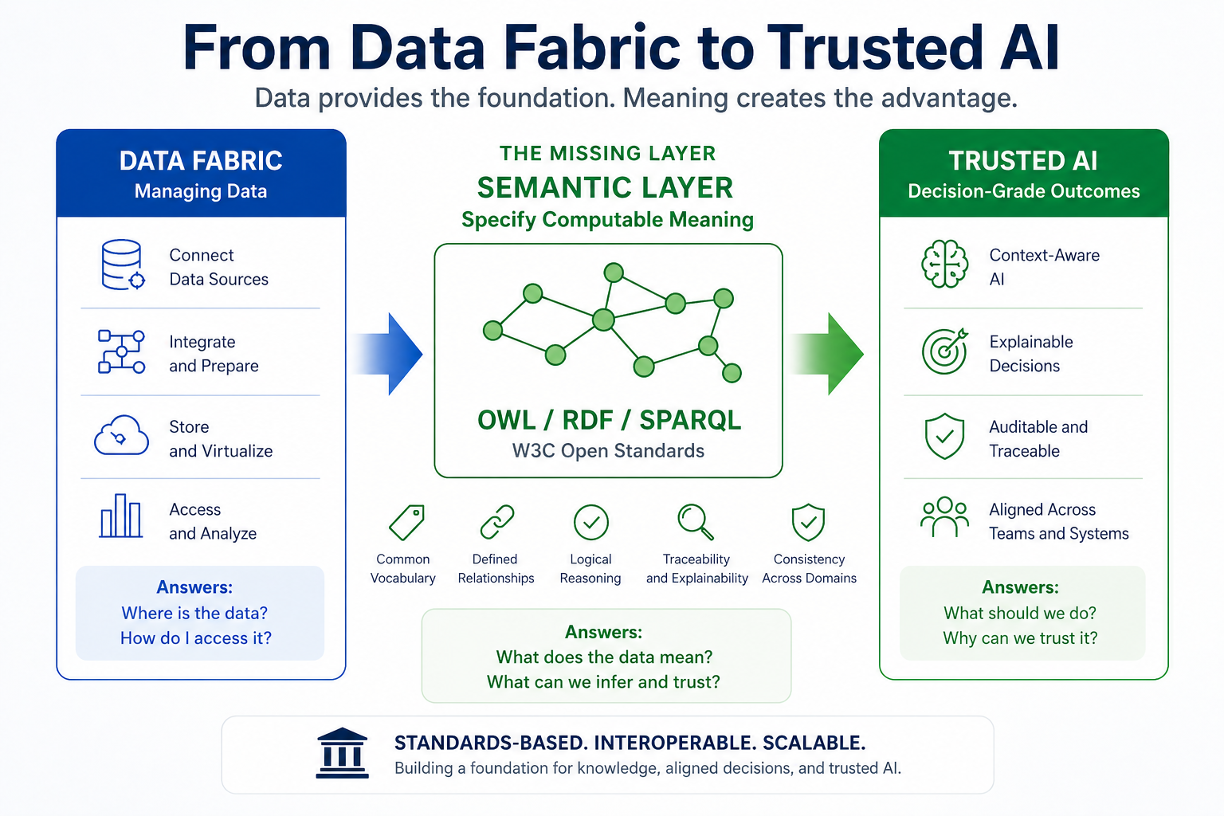
Data platforms enable integration, but only a formal semantic layer, based on open standards, enables machine-understandable meaning, supporting traceable, consistent, and decision-grade AI outcomes.
The Missing Layer: Machine-Understandable Context
This is where formal ontology, built on W3C standards such as OWL, RDF, and SPARQL, plays a distinct role.
Rather than focusing on pipelines, a semantic approach establishes a shared, machine-understandable model of meaning across data. Concepts, relationships, and constraints are defined explicitly and consistently – creating a layer of context that both humans and AI systems can interpret reliably.
This transforms disconnected data into something far more powerful:
A coherent, interoperable system of knowledge.
The Evolution: From Data to Knowledge to Understanding
Most organizations evolve through a predictable progression:
Ad hoc data models → siloed systems with implicit meaning
Graph models → explicit relationships, but loosely defined
Knowledge graphs → connected concepts, but often inconsistent semantics
Formal ontology (OWL/RDF) → explicit, logical, machine-interpretable meaning
Many organizations stop at “graph” or even “knowledge graph,” assuming the problem is solved.
But without a formal model of meaning, these systems remain open to interpretation.
A graph shows connections.
A formal ontology defines what those connections mean, and what follows from them.
Why OWL/RDF Changes the Game
W3C standards such as OWL and RDF are not just data formats. They are formal systems for representing meaning.
This distinction enables several critical capabilities.
1. Explicit, Unambiguous Semantics
Concepts and relationships are formally defined, not implied through labels or documentation. Meaning is encoded directly into the model, reducing ambiguity across systems and teams.
2. Logical Reasoning and Inference
Systems can derive new knowledge from existing facts. Relationships are not just stored; they are understood and extended through inference.
3. Interoperability Through Open Standards
OWL/RDF are globally recognized W3C standards. They enable integration across tools, vendors, and domains without relying on proprietary interpretations.
4. Support for Distributed and Incomplete Knowledge
Operating under an open world assumption, semantic models handle uncertainty and evolving information naturally – critical in defense, intelligence, and complex engineering environments.
5. Querying Across Meaning (SPARQL)
SPARQL enables querying across a semantic model, not just structured data which supports pattern discovery, cross-domain reasoning, and dynamic integration.
Plain Graph vs. Knowledge Graph vs. Formal Ontology
The distinctions are often blurred, but they matter:
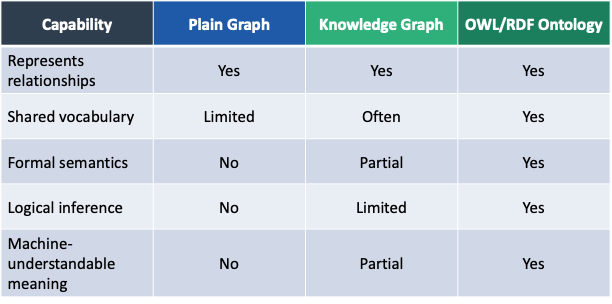
Plain Graph vs Knowledge Graph vs OWL/RDF Ontology
All ontologies are graphs, but not all graphs are ontologies.
Where Data Fabric Fits
Data Fabric technologies are valuable components of modern architectures. But they operate at a different layer.
Data Fabric manages data.
OWL/RDF defines computable meaning.
These approaches are not mutually exclusive; they are complementary.
Data Fabric → ingestion, integration, access, performance
OWL/RDF → semantics, reasoning, trust
Only one provides formal, machine-understandable context.
From Analytics to Trusted AI
The distinction becomes critical when organizations move beyond analytics into AI-driven decision-making.
Traditional platforms retrieve and aggregate data.
Semantic models enable:
Explainability (how was this conclusion reached?)
Traceability (what evidence supports it?)
Consistency (is meaning aligned across systems?)
Auditability (can it be validated?)
Without formal semantics:
AI operates on statistical patterns and labels
Meaning is implicit and inconsistent
Outputs are difficult to trust
With OWL/RDF:
Meaning is explicit and shared
Reasoning is transparent
Context is machine-understandable
How to Explain This to Customers
A simple and effective talk track:
Start with alignment
“Data Fabric and OWL/RDF solve different problems; they work together.”Draw the distinction
“Data Fabric manages data. Ontology defines meaning.”Make it concrete
“A graph shows connections. An ontology explains what those connections mean.”Tie to outcomes
“If you need reporting, Fabric is sufficient. If you need trusted AI, you need formal semantics.”Highlight the risk
“Without ontology, AI is making educated guesses. With ontology, it operates on defined, shared understanding.”
The Strategic Advantage
Organizations that adopt formal ontology gain more than a better data model. They gain a scalable foundation for understanding.
They can:
Reduce ambiguity across systems and organizations
Integrate knowledge dynamically across distributed sources
Enable consistent interpretation across domains
Lower long-term risk through open standards
Provide AI with governed, machine-understandable context
Data platforms scale data.
Ontologies scale understanding.
Final Thought
When a customer asks, “Why OWL/RDF instead of Data Fabric?” the best answer is:
Because they solve different problems.
If the goal is integration, reporting, and data access, a Data Fabric is often sufficient.
If the goal is trusted, explainable, interoperable AI, then something more is required:
A formal, unambiguous, machine-understandable model of reality.
That is the role of OWL/RDF.
And it is foundational to approaches like the Knowledge-Centric Engineering Framework (KCEF), where formal ontology is not an add-on, but the core mechanism for aligning data, context, and decision-making into a coherent, trustworthy system.
Further reading
Our approach to knowledge-centric solutions: https://crownpoint.tech/kcef-explained
(Optional deep dives) Meaning layer • Execution fabric • Orchestration • Goal-oriented UX