

From Transactional Systems to Goal-Oriented Experience
Why User Experience Must Evolve in the Age of Governed Autonomy
Across the last three articles, we have followed a deliberate progression.
We began with token overload: the recognition that simply adding more text to large language models does not produce clarity. Without shared semantics, systems reason over ambiguity. Context windows expand, retrieval pipelines multiply, but meaning remains unstable.
We then introduced knowledge-governed execution: the idea that ontologies and knowledge graphs provide the structural foundation required to stabilize meaning and encode policy. When knowledge is explicit and constraints are formalized, systems can move from probabilistic suggestion to bounded, reliable action.
Finally, we explored agent orchestration: demonstrating that autonomy only becomes trustworthy when agents operate inside that governed semantic fabric. Agents can decompose goals, select tools, and coordinate execution, but they must do so within shared meaning and explicit policy boundaries.
This brings us to the most visible transformation of all.
If agents can act across systems within a knowledge-governed architecture through the Knowledge-Centric Engineering Framework (KCEF), then the user experience itself must change. The interface cannot remain transactional while the architecture beneath it becomes goal-driven.
The shift from transactional interaction to goal-oriented experience is not cosmetic. It is architectural.
The Burden of Orchestration
Most enterprise and mission systems are built around transactions. Users navigate application boundaries, execute discrete functions, move data manually between systems, and reconcile inconsistencies through experience and judgment. Even where integrations exist, they typically reflect point-to-point stitching. The burden of orchestration falls on the human.
This model persists because our architectures were application-centric. Each system encoded its own definitions, workflows, and constraints. To accomplish a cross-cutting objective, a person had to mentally decompose the goal and traverse multiple tools.
The friction we experience daily – exporting data, re-entering values, reconciling terminology, checking permissions, tracking approvals – is not simply inefficiency. It is architectural debt.
We have normalized the idea that humans must act as middleware.
But once semantics are shared and agents operate within a governed execution fabric, that assumption breaks down.
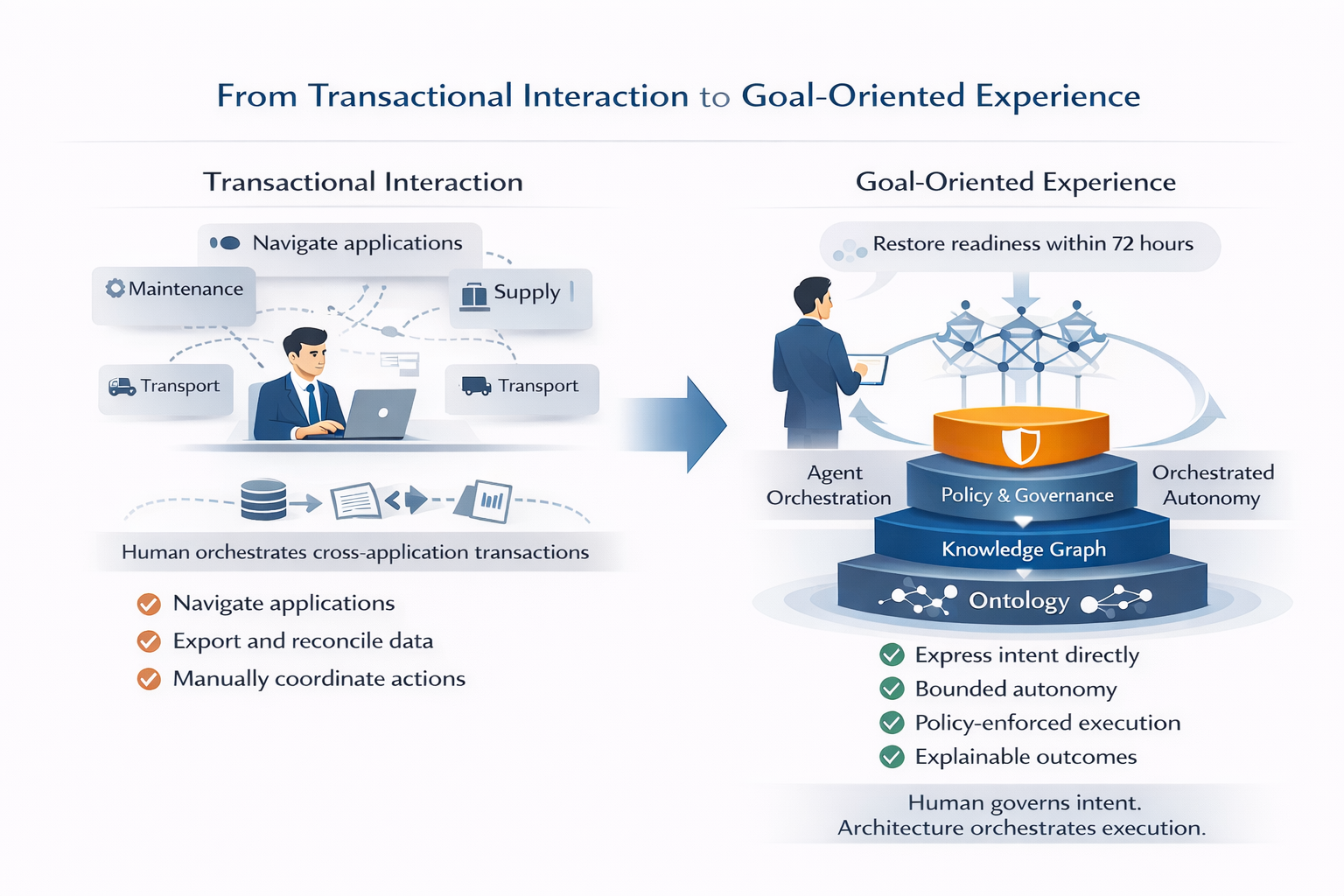
From Transactional Interaction to Goal-Oriented Experience: In transactional systems, humans orchestrate across applications. In goal-oriented UX on KCEF-style stacks, humans define intent while knowledge-governed orchestration coordinates execution within policy boundaries (bounded autonomy).
The illustration contrasts two fundamentally different interaction models. On the left, the user is surrounded by disconnected applications – maintenance, supply, transport – manually navigating between systems and reconciling data. The human acts as the orchestrator, stitching together transactions across fragmented tools. On the right, the user expresses a clear objective (e.g., restoring readiness within a defined time horizon), while a structured stack beneath provides shared semantics (ontology + knowledge graph), policy governance, and agent orchestration. Instead of coordinating applications directly, the human governs intent, and the architecture decomposes and executes actions with bounded autonomy. The visual reinforces the central thesis of this series: when meaning and policy are embedded into the foundation, the user experience rises from transactions to outcomes.
The user no longer asks:
Which application contains this function?
Which system owns this data?
Who must I contact for approval?
Instead, the user expresses:
Restore readiness within seventy-two hours
Assess operational risk across theaters
Identify supply chain vulnerabilities affecting this program
The system decomposes the goal across capabilities, and the architecture orchestrates.
The human governs.
Consider the following examples.
When Architecture Changes, Interaction Changes
A knowledge-centric architecture redefines the center of gravity. Ontologies harmonize definitions (meaning) across domains. Knowledge graphs unify state and relationships. Policies become explicit and enforceable. Agents operate within these boundaries, decomposing intent into coordinated execution.
When that foundation exists, the natural interface rises to the level of objectives. The contrast is easiest to see visually.
Restoring Readiness Under Contested Logistics
Consider a joint force operating under contested sustainment conditions. A brigade reports multiple mission-essential systems degrading due to a common failure mode. The commander’s intent is clear: restore readiness within seventy-two hours.
In today’s transactional environment, this initiates a scramble. Maintenance systems contain diagnostics. Supply systems track stock positions and substitutes. Transportation systems manage lift schedules and route constraints. Authority rules govern reallocations. Some information is classified or compartmented. Definitions vary across echelons.
Humans construct a temporary “digital thread” by querying systems, exporting spreadsheets, reconciling identifiers, and manually generating courses of action.
The workflow is fragile because meaning is embedded inside disconnected systems.
In a knowledge-governed environment, the same objective unfolds differently.
Asset identity, configuration, fault codes, authorized substitutes, stock availability, movement feasibility, classification rules, and release authority are linked into a continuous, queryable operational thread. The architecture maintains semantic integrity across domains.
Agents detect patterns, evaluate authorized substitutions, allocate scarce inventory according to mission priority, and generate feasible transportation plans that respect clearance and policy constraints. Actions exceeding predefined risk thresholds route to human authorities. Each recommendation carries explainable rationale and preserved provenance from fact to decision.
The commander does not orchestrate applications. They evaluate aligned courses of action.
The experience changes because the architecture changed.
From Aggregation to Insight in Intelligence Analysis
A similar transformation applies to intelligence workflows.
Today, analysts often spend days or weeks discovering, querying, exporting, and reconciling information from heterogeneous sources before producing a finished assessment. Downstream consumers must then reinterpret and reassemble context for their own decisions.
Much of the cognitive effort is consumed by aggregation rather than analysis.
In a knowledge-centric architecture, entities, relationships, constraints, and provenance are harmonized into a shared semantic layer. An analyst can express an objective directly: assess the likelihood of supply chain disruption affecting an operational theater within the next thirty days.
Agents traverse normalized entities and relationships, apply analytic models encoded in ontology, enforce dissemination rules at query time, and attach lineage and confidence to outputs. Assumptions are explicit. Provenance is preserved. Policy is enforced in real time.
The analyst shifts from manual compilation to validation, refinement, and interpretation.
Again, the visible change in user experience is the result of architectural coherence.
The Inevitable Shift
Goal-oriented UX is not a conversational veneer layered onto legacy systems. Without shared semantics and governed orchestration, a chatbot simply triggers brittle APIs. The illusion of intelligence reappears, but fragmentation persists underneath.
True goal-oriented experience emerges only when meaning is stabilized, policy is encoded, and execution is governed.
What was once described as a “Semantic Web” vision of explicit meaning shared across systems now finds its practical expression inside the enterprise. Not as a universal data mandate, but as semantic interfaces, federated access, and policy-governed orchestration. Goal-oriented experience is what naturally emerges when that meaning layer becomes operational.
As architectures mature toward shared semantics and governed orchestration, transactional UX becomes the bottleneck. Humans navigating screens cannot keep pace with systems capable of decomposing goals across domains in milliseconds.
The cognitive load imposed by application boundaries becomes unjustifiable once those boundaries are no longer structurally necessary.
Just as graphical interfaces replaced command-line interactions when abstraction improved, goal-oriented experience will replace transactional workflows when architectural foundations support it.
The question is not whether users prefer expressing intent. The question is whether organizations will design the underlying systems that make such interaction trustworthy.
Recapping the progression,
Token overload revealed the instability of unstructured reasoning.
Semantics stabilized meaning.
Knowledge governance bounded execution.
Agent orchestration operationalized autonomy within structure.
Goal-oriented experience is the visible consequence of that progression.
When meaning is shared, policy is explicit, and autonomy is bounded, the interface cannot remain transactional. It must evolve.
That shift is not a feature enhancement.
It is an inevitability.
Key Takeaways
Move from transactions to outcomes. Goal-oriented UX lets users express intent in operational terms, “restore readiness, reduce risk, meet SLAs,” instead of stitching actions across apps.
Intent becomes a governed goal. Goals are translated into structured, testable objectives with clear constraints, assumptions, and success criteria; so the system can act predictably.
Execution stays within policy. Orchestration coordinates the right data, services, and agents while enforcing authority, access, and compliance requirements by design.
Autonomy is measurable and controllable. Low-risk actions can proceed automatically; higher-impact decisions route to designated approvers with explainable rationale.
Less user burden, more leverage. Users shift from manual reconciliation and navigation to supervision, judgment, and decision-making — supported by actionable context.
Adaptation becomes easier. When goals, semantics, and policies are explicit, workflows can evolve as tools and conditions change, and without constant reengineering.