

Knowledge-Centric Engineering Framework Explained
From Explicit Meaning to Governed, Goal-Oriented Execution
Organizations have invested heavily in data platforms, integration, and AI. Yet many critical outcomes still depend on people manually reconciling systems, interpreting inconsistent definitions, and stitching workflows together under time pressure.
The problem is not a lack of data. It is a lack of durable, shared meaning and governed coordination.
The Knowledge-Centric Engineering Framework (KCEF) is a knowledge-governed architectural approach that transforms explicit semantic meaning into reliable, policy-aligned execution. It aligns human intent, coordinated planning, and bounded automation through a layered architecture designed for interoperability and safe evolution.
If you are exploring why explicit semantic meaning is required in the first place, see
→ Machine-Understandable Context: Why Explicit Meaning Is Required for Reliable Automation
KCEF is not a product and not a rip-and-replace modernization effort. It is an engineering framework for making meaning durable, autonomy governable, and execution verifiable across complex environments.
The Execution Gap
In many organizations, integration still means building point-to-point connections tightly coupled to specific applications. As systems proliferate, the cost of change rises. Each new data source, policy adjustment, model revision, or operational constraint triggers cascading rework.
AI often accelerates analysis but exposes a deeper issue: translating insights into coordinated, policy-compliant action remains brittle and human-dependent when meaning is implicit.
KCEF addresses this execution gap by separating four concerns:
Human intent and governance
Goal decomposition and coordination
Runtime execution and control
Durable semantic meaning
This separation allows autonomy to scale without sacrificing accountability.
The KCEF Layered Architecture
KCEF is structured as four cooperating layers. Each layer builds on the semantic foundation beneath it.
Execution depends on orchestration.
Orchestration depends on explicit meaning.
Meaning depends on a durable semantic substrate.
For the architectural foundation that makes shared meaning scalable and evolvable, see
→ Building the Distributed Knowledge Substrate for KCEF
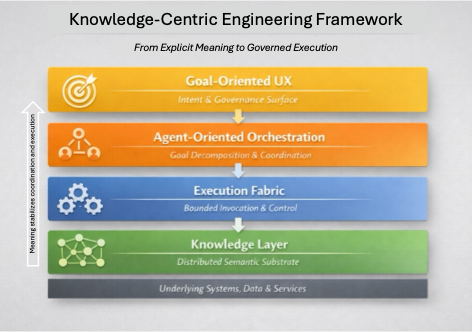
KCEF transforms intent into governed outcomes by layering goal-oriented interaction, policy-aware orchestration, controlled execution, and a durable semantic foundation of shared meaning.
KCEF is structured as a four-layer architecture in which each layer depends on the semantic foundation beneath it.
At the base, the Knowledge Layer is implemented as a distributed semantic substrate. It provides formal domain ontologies, knowledge graphs, globally unique identifiers (IRIs), policy-linked entities, constraint models, and provenance. This layer establishes durable, machine-interpretable meaning that is decoupled from any specific application or data store and supports evolvable models under the Open World Assumption with deterministic validation safeguards.
Above it, the Execution Fabric provides bounded invocation and runtime control. It enforces policy, manages resilience patterns (retry, failover, idempotency), captures observability and provenance, and ensures that automated actions remain auditable and accountable.
The Agent-Oriented Orchestration Layer operates on explicit semantic definitions and policy constraints to decompose structured goals into coordinated plans. It selects resources using semantic capability descriptions, applies authority boundaries, and manages human-in-the-loop and human-on-the-loop interaction patterns.
At the top, Goal-Oriented UX serves as the governance surface. It compiles human intent into structured, verifiable goal specifications that include objectives, constraints, validation criteria, and required authorities. This layer enables controlled autonomy by ensuring that intent is explicit before coordination begins.
The flow is top-down for intent and bottom-up for validation and provenance. Meaning stabilizes execution; policy bounds orchestration; humans govern objectives.
1. Goal-Oriented UX (Intent & Governance Surface)
At the top of the stack, Goal-Oriented UX transforms interaction from transactional navigation to structured objectives.
Instead of manually operating applications, users express intent:
Restore operational readiness within seventy-two hours
Assess risk exposure across supply nodes
Identify mission-impacting resource constraints
The interface becomes a governance surface for intent. Goals are structured with explicit constraints, authority boundaries, and validation criteria before coordination begins.
Humans remain accountable. The system coordinates within defined policy bounds.
This shift from interaction to intention is architectural, not cosmetic. It is possible only because shared meaning and policy definitions exist beneath the interface.
For a deeper treatment of this interaction model, see
→ From Transactional Interaction to Goal-Oriented Experience
2. Agent-Oriented Orchestration Layer
Beneath the interface, agent-based orchestration translates structured goals into coordinated plans.
This layer:
Decomposes goals into tasks and sub-goals
Selects resources based on semantic capability descriptions
Applies authority, timing, and policy constraints
Coordinates actions across distributed systems
Manages human-in-the-loop and human-on-the-loop workflows
Agents do not invent meaning. They operate on explicit semantic definitions provided by the Knowledge Layer.
Coordination is based on shared concepts and policy constraints, not brittle integration logic.
For a deeper treatment of the agent orchestration layer, see
→ Agent Orchestration: From Semantics to Governed Autonomy
3. Execution Fabric (Bounded Invocation & Runtime Control)
The execution fabric carries out coordinated plans under guardrails.
It provides:
Runtime policy enforcement
Resilience patterns (retry, failover, idempotency)
Monitoring and observability
State management
Provenance capture and auditability
This layer focuses on invocation and control — not reasoning. It ensures that actions remain bounded, observable, and compliant with defined constraints.
Autonomy without runtime enforcement is risk. Execution fabric makes autonomy accountable.
For a deeper treatment of the agent orchestration layer, see
→ The Knowledge Execution Fabric: Making Knowledge-Centric Systems Actionable at Enterprise Scale
4. Knowledge Layer (Distributed Semantic Substrate — Foundation
At the foundation of KCEF is the Knowledge Layer, implemented as a distributed semantic substrate.
This layer formalizes:
Domain ontologies (concepts, relationships, constraints)
Knowledge graphs (entities, events, states, provenance)
Stable global identifiers (IRIs) decoupled from application-specific keys
Policy-linked entities and validation constraints
Evolvable semantic models operating under the Open World Assumption
The Knowledge Layer provides the structural basis for interoperability, validation, and governance. It decouples meaning from implementation so that systems can evolve without semantic drift.
Because meaning is explicit and machine-interpretable:
Orchestration can rely on defined relationships rather than naming conventions
Execution can validate constraints before action
Policy enforcement can reference shared semantic entities
Provenance can be attached directly to assertions
Meaning becomes durable infrastructure rather than documentation.
For a detailed architectural explanation of this semantic foundation, see
→ Building the Distributed Knowledge Substrate for KCEF
Trust, Assurance, and Governance
As systems move from insight generation to action coordination, trust must be architectural.
KCEF builds trust from:
Explicit semantics
Deterministic validation
Runtime policy enforcement
Provenance and lineage
Clear human authority boundaries
Human-in-the-loop and human-on-the-loop models preserve accountability. Responsibility does not transfer to automation.
Verification and validation become structural properties of the system, not afterthoughts.
Relationship to the Broader Architecture
Machine-understandable context establishes why explicit semantic meaning is required
The distributed semantic substrate explains how that meaning scales across systems
KCEF integrates that foundation with orchestration and governed execution
Goal-Oriented UX exposes that architecture as a human-centered governance surface
Together, these form a coherent architecture for interoperable, trustworthy autonomy.
Why Crown Point
KCEF reflects Crown Point’s applied experience engineering semantic interoperability and governed execution in complex, regulated, and mission-critical environments.
Our differentiator is not simply knowledge graph expertise or AI integration. It is the disciplined combination of:
Formal ontology and knowledge graph modeling for shared meaning and semantic interoperability
Stable identifier strategies that decouple meaning from implementation
Policy-linked validation and governance patterns that make autonomy bounded and auditable
Practical integration methods that connect semantic foundations to operational systems
We treat semantics as infrastructure, not enrichment.
Crown Point helps organizations:
Define and formalize domain meaning
Implement distributed semantic substrates that scale under change
Integrate semantic models with orchestration and execution systems
Introduce governed autonomy incrementally and responsibly
The result is knowledge-governed execution, not experimental AI layered onto brittle systems.
Key Takeaways
Reliable automation requires explicit meaning. Machines cannot coordinate safely when semantics remain implicit.
The Knowledge Layer, implemented as a distributed semantic substrate, is the foundation of KCEF. It makes meaning durable, interoperable, and evolvable.
Agent-oriented orchestration operates on explicit semantic definitions and policy constraints, enabling coordinated planning across systems.
The execution fabric enforces runtime policy and auditability, keeping autonomy bounded and accountable.
Goal-Oriented UX elevates interaction from transactions to structured objectives, allowing humans to govern intent while the architecture coordinates execution within defined constraints.
Explicit meaning is infrastructure.
Governed autonomy is engineered.
Goal-oriented execution is the outcome.