

The Knowledge Execution Fabric
Making Knowledge-Centric Systems Actionable at Enterprise Scale
Modern enterprises are saturated with “authoritative” systems, for example, in digital engineering, include workflow tools, requirements tools, PLM/PDM, MBSE environments, manufacturing execution, sustainment records, logistics data, and analytics environments. Each system is internally consistent, but the enterprise is not. Programs compensate by exporting spreadsheets, reconciling baselines by hand, and rebuilding traceability at every major decision point.
The Knowledge-Centric Engineering Framework (KCEF) argues that the path forward is not another integration program, but an architectural shift: make meaning explicit, govern it, and execute against it. This paper describes the Knowledge Execution Fabric as the runtime layer in that shift, and how it turns a semantic foundation into repeatable, policy-bounded decisions and actions.
Read the KCEF overview for context: KCEF Explained.
Why a Knowledge Execution Layer Exists
KCEF organizes the architecture into complementary layers. The Knowledge Layer establishes shared semantics (ontologies/knowledge graphs), so systems and people can refer to the same concepts consistently. The Knowledge Execution Fabric sits above that foundation and provides the operational mechanisms to use semantics in real workflows—reconciling change, enforcing policy, producing explainable outcomes, and coordinating actions across tools.
When this layer is missing, enterprises fall back to two brittle extremes:
Point-to-point integrations that hard-code assumptions and break with every tool or schema change
Human reconciliation processes that are slow, inconsistent, and difficult to audit
The Knowledge Execution Fabric avoids both by making execution knowledge-governed: policy, traceability, and decision logic bind to the semantic model, not to any single vendor tool.
Explore the semantic foundation: Semantic Substrate.
What the Knowledge Execution Fabric Does
At enterprise scale, a Knowledge Execution Fabric provides a small set of high-leverage capabilities that sit between knowledge and operations:
Context assembly and grounding. It composes decision-ready context from multiple sources – requirements, models, parts, changes, approvals – into a coherent, queryable view.
Policy-bounded reasoning. It applies rules, constraints, and access controls to ensure that recommendations and actions stay within governance boundaries.
Traceable change and impact. It computes multi-hop dependencies across artifacts so teams can understand what changes mean and what they affect.
Orchestrated action. It coordinates workflow steps across systems, such as publishing, synchronizing, validating, and updating baselines.
Explainability and auditability. It produces human-readable rationales and machine-verifiable provenance for decisions and updates.
These functions are intentionally tool-agnostic. The goal is enterprise continuity: you can replace tools, swap vendors, or introduce new systems without re-implementing the logic of meaning and governance.
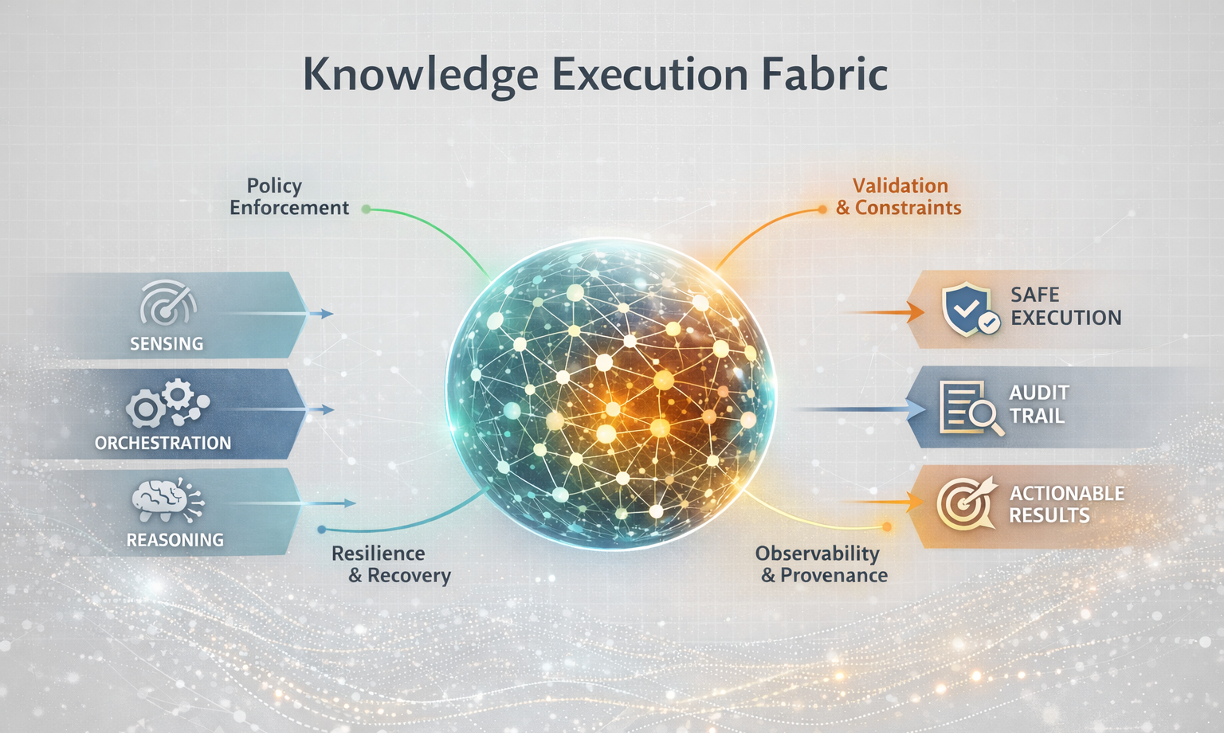
The Knowledge Execution Fabric bridges both sides of the Knowledge Layer, preparing raw inputs for connection and normalization, and powering governed access and action on knowledge-enabled assets (ontologies, semantic endpoints, and knowledge graphs).
The Knowledge Execution Fabric serves as the operational “bridge” that works both below and above the Knowledge Layer. On the left, it takes in raw, heterogeneous inputs through sensing, orchestration, and reasoning, translating and coordinating them so they can be validated, governed, and connected into the knowledge substrate. In the center, the connected sphere represents the fabric’s continuous execution environment where policies, resilience, and operational controls are applied as data and intent flow through. On the right, the fabric drives knowledge-enabled access and action—enforcing validation and constraints, maintaining observability and provenance, and producing outcomes such as safe execution, auditable traceability, and actionable results that applications and users can trust.
How It Fits with Agents and Goal-Oriented Experience
Modern agent systems can accelerate engineering work, but only when they operate on stable meaning and controlled execution. In KCEF terms, agents are most useful when they become clients of the Knowledge Execution Fabric rather than free-running automation.
The pattern is simple:
A goal-oriented experience captures intent (“prepare change package,” “validate traceability,” “summarize impact for review”)
Agent orchestration decomposes the goal into tasks and selects tools
The Knowledge Execution Fabric supplies governed context, enforces constraints, and records provenance so outcomes are reliable
This is how the architecture moves from “AI suggests” to “enterprise executes with control.”
Related reading:
Goal-oriented experience: Goal-Oriented UX
Agent orchestration: Agent Orchestration
Agent systems framing: Agent Triad
Decoupling, Vendor Neutrality, and Risk Reduction
A core benefit of the Knowledge Execution Fabric is architectural decoupling. Instead of encoding logic inside a specific PLM, MBSE tool, or bespoke integration stack, execution binds to shared semantics and open interfaces. That reduces three persistent risks:
Vendor lock-in risk: programs can evolve toolchains without losing governance or meaning
Integration fragility risk: changes propagate through the semantic model, not brittle connector logic
Decision risk: impact analysis and approvals become traceable and repeatable rather than ad hoc
For defense and mission engineering environments, this translates into faster reviews with fewer surprises, improved configuration integrity, and continuity across modernization cycles.
A Concrete Example: Gemstone as a Knowledge Execution Fabric
Gemstone is an operational implementation of this pattern: a semantic digital thread accelerator deployed in mission environments that unifies engineering and lifecycle data into a governed, configuration-aware fabric. In KCEF terms, Gemstone functions as a Knowledge Execution Fabric by providing graph-native services for synchronization, change impact analysis, traceability, and controlled publishing which decouples programs from point-to-point integrations while preserving auditability and policy enforcement.
Learn more about Gemstone: Gemstone Page.
What Readers Should Take Away
KCEF is not just a semantic modeling philosophy; it is an operational architecture. The Knowledge Execution Fabric is the layer that turns governed meaning into enterprise outcomes: faster change cycles, lower integration risk, and explainable, audit-ready decisions. When paired with goal-oriented experience and agent orchestration, it becomes the runtime that lets organizations scale AI assistance without sacrificing control.
Continue the series:
KCEF overview: KCEF Explained
Knowledge layer foundation: Knowledge Layer
Goal-oriented experience: Goal-Oriented UX
Agent orchestration: Agent Orchestration