

Knowledge-Centric Engineering Framework (KCEF)
From data and systems to governable, outcome-driven execution
Crown Point’s KCEF is a knowledge-centric architectural approach that enables governed AI and bounded autonomy to help organizations move from information to action with behaviors aligned to mission and business objectives. KCEF establishes a durable Knowledge (Meaning) Layer — implemented as a distributed semantic substrate using ontologies, knowledge graphs, stable identifiers, and explicit constraints — and then applies policy and orchestration to make complex workflows easier to change, more reliable to operate, and more trustworthy at scale.
For a detailed architectural walkthrough of how these layers integrate into a coherent framework, see KCEF Explained.
The Challenge
Most organizations have plenty of data and systems, but struggle to turn them into consistent, repeatable execution. Workflows are often stitched together by hand, meaning varies across data and functions, and change requires expensive rework. The result: slow cycles, brittle integrations, and growing operational complexity.
What KCEF is
It establishes a shared semantic foundation across data, services, and processes implemented as a distributed semantic substrate that formalizes meaning, relationships, constraints, and provenance; and then uses that foundation to enable increasing autonomy. Shared understanding becomes reliable, verifiable behavior aligned to mission and business outcomes through policy-controlled workflows.
Goal-Oriented UX: GoUX replaces transactional workflows with structured objectives, allowing users to express intent while the system coordinates execution within explicit policy and authority boundaries.
Orchestration layer: Workflows are coordinated using semantic descriptions and policy constraints — improving reuse, adaptability, consistency, and control as conditions change.
Execution fabric: A distributed runtime invokes actions with embedded policy enforcement, resilience patterns, monitoring, and auditability — keeping autonomy bounded, observable, and accountable.
Knowledge layer: Implemented as a distributed semantic substrate, the Knowledge Layer uses ontologies and knowledge graphs to formalize meaning, relationships, constraints, and provenance — creating actionable context for interoperability, validation, and governance.
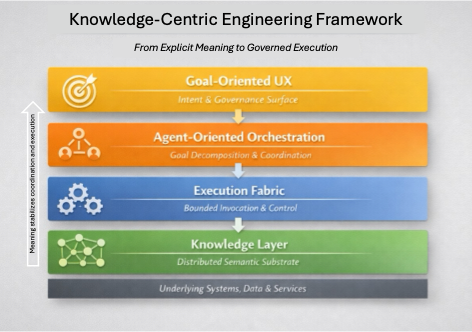
KCEF is not a single product and not a rip-and-replace platform. It’s an architectural framework that leverages existing investments and improves how they’re understood, connected, and governed.
Why Crown Point
KCEF is built on Crown Point’s experience delivering the foundations for knowledge-centric interoperability and execution, especially where environments are complex, regulated, or mission-critical.
Ontology & Knowledge Graph expertise for shared meaning, semantic interoperability, and explainability
A repeatable knowledge modeling process (domain scoping → lexicon → taxonomy → formal models → integration)
Semantic Digital Thread solutions that unify lifecycle data across complex environments
A practical path from proof of concept → pilot → MVP → production
What Makes KCEF Different
Interoperability based on meaning — not point integrations
Resources are described by what they mean and what they require, using shared semantic identifiers and formal models. This creates a reusable foundation for discovery and composition, so you don’t rebuild brittle integration logic for every new workflow.
Change becomes configuration, not reengineering
When meaning and constraints are captured in the knowledge layer, many updates can be made by adjusting semantic mappings and policies — without rewriting large portions of the stack.
Governance is built in
KCEF emphasizes policy, provenance, and auditability so workflows are reviewable, defensible, and operationally reliable.
What You Get
Faster adaptation: Integrate new resources by updating semantic descriptions—not rewriting integrations
Reduced complexity: Fewer one-off pipelines and less manual stitching across systems
More consistent decisions: Shared definitions and relationships reduce ambiguity and mismatch
Trust and traceability: Policy, provenance, and auditability are designed in from day one
Turn shared meaning into governed execution.
KCEF helps you move from fragmented data and disconnected workflows to policy-controlled, outcome-driven operations. If you’re exploring knowledge graphs, semantic interoperability, or bounded autonomy, we can help you scope a pilot and define an adoption path.
How We Engage
Assess & align
Define the domain scope, priorities, and the key questions your environment must answer—then identify the workflows where shared meaning will deliver the biggest return.
Model & integrate
Build or extend ontologies, map them to your data, services and other resources, and publish a knowledge graph view that makes concepts, entities, and capabilities consistent and reusable.
Operationalize & scale
Introduce governed orchestration patterns and scale iteratively — expanding domains, increasing reuse, and improving reliability as value is proven.
FAQ
Is KCEF a platform you sell?
KCEF is an architectural framework. Crown Point helps you design and implement the knowledge layer, integration pattern, and governance model using proven technologies.
Do we have to replace our systems?
No. KCEF is designed for incremental adoption and works with existing investments.
How does KCEF relate to data fabric or integration initiatives?
KCEF complements data and integration platforms by implementing a formal Knowledge Layer implemented as a distributed semantic substrate of shared meaning, relationships, constraints, and provenance, so those platforms can deliver more consistent, governable outcomes.
Ready to make execution more consistent and governable?
If you’re modernizing data, integration, or decision workflows — and want a durable “meaning layer” that reduces rework — let’s talk about what KCEF could look like in your environment.