
From Token Overload to Knowledge-Governed Execution: Ontologies as the Interoperability Layer in KCEF
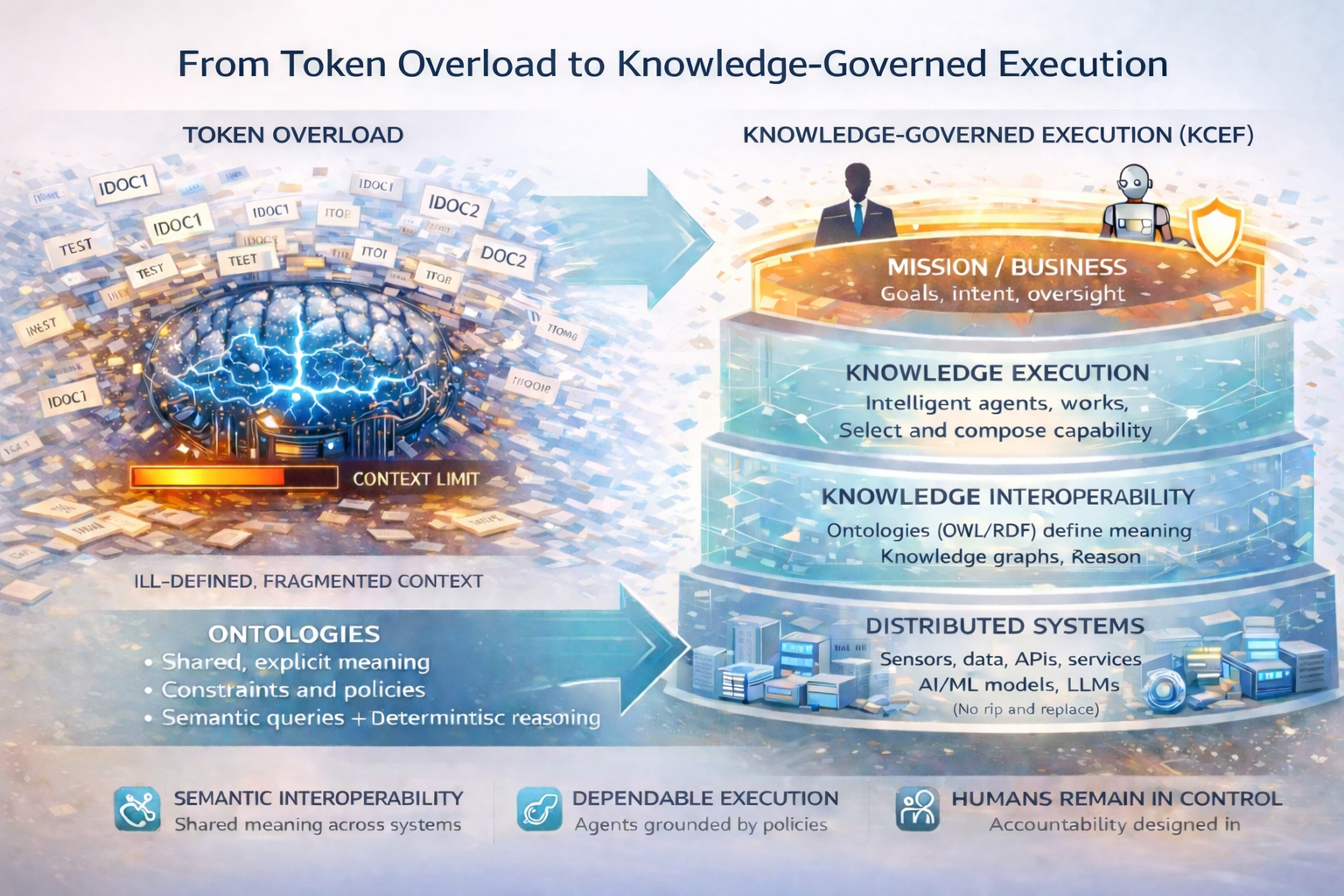
Shifting from token overload — LLMs trapped in fragmented, bounded contextçto Knowledge-Governed Execution (KCEF), where ontologies and knowledge graphs make meaning explicit, interoperable, and policy-governed. That semantic foundation enables agents to reliably compose and execute capabilities across distributed systems, while humans retain mission/business oversight and accountability.
In a previous post, we described a shift many of us are now experiencing firsthand: we’ve moved from an era of information overload, where humans were overwhelmed by documents, to an era of token overload, where large language models are constrained by bounded context windows. While the actors have changed, the underlying problem has not: too much unstructured text competing for a limited reasoning space.
Generative AI has made this visible. As prompts grow longer and retrieval pipelines return loosely related passages, models are forced to reconcile ambiguity, redundancy, and contradiction inside a narrow reasoning workspace. The symptoms – truncation, attention dilution, inconsistency, hallucination – are not model failures. They are architectural failures.
This is where knowledge-centric architecture enters the conversation; not as a bolt-on to AI, but as the missing foundation.
From Grounding to Governance
Much of today’s discussion frames knowledge graphs as a way to ground LLMs. While grounding is necessary, it is insufficient. The deeper value lies in making meaning explicit and governable.
In the Knowledge-Centric Engineering Framework (KCEF), semantic knowledge – not applications – governs how capabilities are discovered, composed, and executed. Ontologies and knowledge graphs do not store text; they encode meaning, relationships, constraints, and provenance in machine-interpretable form. This is what allows them to act as semantic compression for LLMs, reducing token load while increasing precision.
But more importantly, they establish a shared, durable semantic foundation across systems, organizations, and time.
Ontologies as the Knowledge Interoperability Layer
At their core, ontologies answer a deceptively simple question: what do things mean, and how are they related? In complex enterprises, the absence of a shared answer is the root cause of brittle integrations, manual coordination, and stalled digital transformation.
Traditional integration assumes a closed world: fixed schemas, implicit meaning, and high-cost change. Ontology-driven systems invert this model. With OWL’s open-world assumption, change is expected. New concepts, data sources, and relationships can be introduced without destabilizing existing solutions.
Within KCEF, this semantic layer becomes the knowledge interoperability layer which decouples meaning from implementation. Data remains distributed for valid operational reasons, but meaning is unified. Systems no longer need to “know each other;” they only need to align semantically.
This is the inflection point where digital transformation stops being about data movement and starts being about knowledge coherence.
Why Agentic Systems Depend on Ontologies
As we move from copilots toward agentic systems, the limitations of unstructured context become existential. Agents must reason over time, persist state, operate under constraints, and coordinate with both humans and other agents.
Ontologies provide the scaffolding that makes this possible.
In KCEF terms, the knowledge layer supplies:
Shared memory: a persistent, authoritative world model
Structure: explicit concepts and relationships that prevent semantic drift
Constraints and policy hooks: defining what is allowed, expected, or prohibited
Actionable context: knowledge that is already disambiguated and execution-ready
Agents do not invent meaning. They reason over knowledge and translate intent into action through governed execution pathways.
Without this semantic foundation, autonomy fragments. With it, autonomy scales…without surrendering control.
From Knowledge to Execution — and Beyond
Seen through the KCEF lens, ontologies and knowledge graphs form the first and most critical layer of a larger architecture: the layer that enables sustained interoperability and machine reasoning.
But interoperability alone does not produce outcomes.
The next layer is knowledge execution: agent-based orchestration that interprets goals, selects capabilities, and assembles workflows dynamically, while remaining bounded by policy, provenance, and human oversight.
Beyond that lies the mission and business layer, where humans and AI partner. Humans define intent, constraints, and success criteria. Machines handle speed, scale, and coordination. Accountability remains human.
This layered progression – from knowledge interoperability, to execution, to mission outcomes – is the architectural arc of KCEF.
Those next layers will be the focus of the articles to follow.
More to come.
From Knowledge to Bounded Autonomy
This progression from token overload, to semantic interoperability, to agentic execution is not theoretical. It reflects a practical architectural shift already underway in complex enterprises and mission environments.
The Knowledge-Centric Engineering Framework formalizes this shift by placing semantic knowledge at the center of execution. Ontologies and knowledge graphs establish shared meaning. Intelligent agents reason over that meaning to interpret goals and assemble workflows. A policy-governed execution fabric ensures actions remain resilient, auditable, and aligned with human intent.
KCEF is not a product or a rip-and-replace platform. It is an architectural approach that leverages existing systems while transforming how they are understood, composed, and operated.
If your organization is investing in AI, agents, or autonomy, and struggling with fragmentation, trust, or scale—the problem is likely not your models. It is your knowledge foundation.
Crown Point helps organizations move from data integration to knowledge-governed execution.