
From Federated Data to Governed Execution
How to Operationalize the IC Data Reference Architecture Across Mission and Engineering Ecosystems
Across the Intelligence Community, the Department of Defense, and increasingly across industry, organizations are confronting the same structural reality: their environments are rich with data, but coordination remains fragile.
Systems connect. APIs proliferate. Data fabrics and meshes promise integration at scale. Yet when mission objectives shift, engineering baselines change, or cross-domain decisions must be made under time pressure, people still become the integrators. They reconcile definitions. They interpret policy. They stitch together workflows across tools that were never designed to share durable meaning.
The Intelligence Community Data Reference Architecture (IC DRA) represents an important and necessary response to this condition. It recognizes that interoperability is not primarily a transport problem. It is a meaning problem.
By formalizing federated domain ownership, shared semantic standards, lifecycle governance, and computational enforcement, the IC DRA stabilizes the foundation beneath distributed ecosystems. It separates semantic identity from implementation. It allows domains to evolve without semantic fragmentation. It makes governance computable rather than procedural.
But stabilizing data is not the end state.
Mission environments, digital engineering programs, and complex enterprises do not merely need interoperable data. They need governed execution, i.e., coordinated action across domains, under authority constraints, with traceability and assurance.
This is where the Knowledge-Centric Engineering Framework (KCEF) enters the picture.
KCEF does not compete with the IC DRA. It operationalizes it.
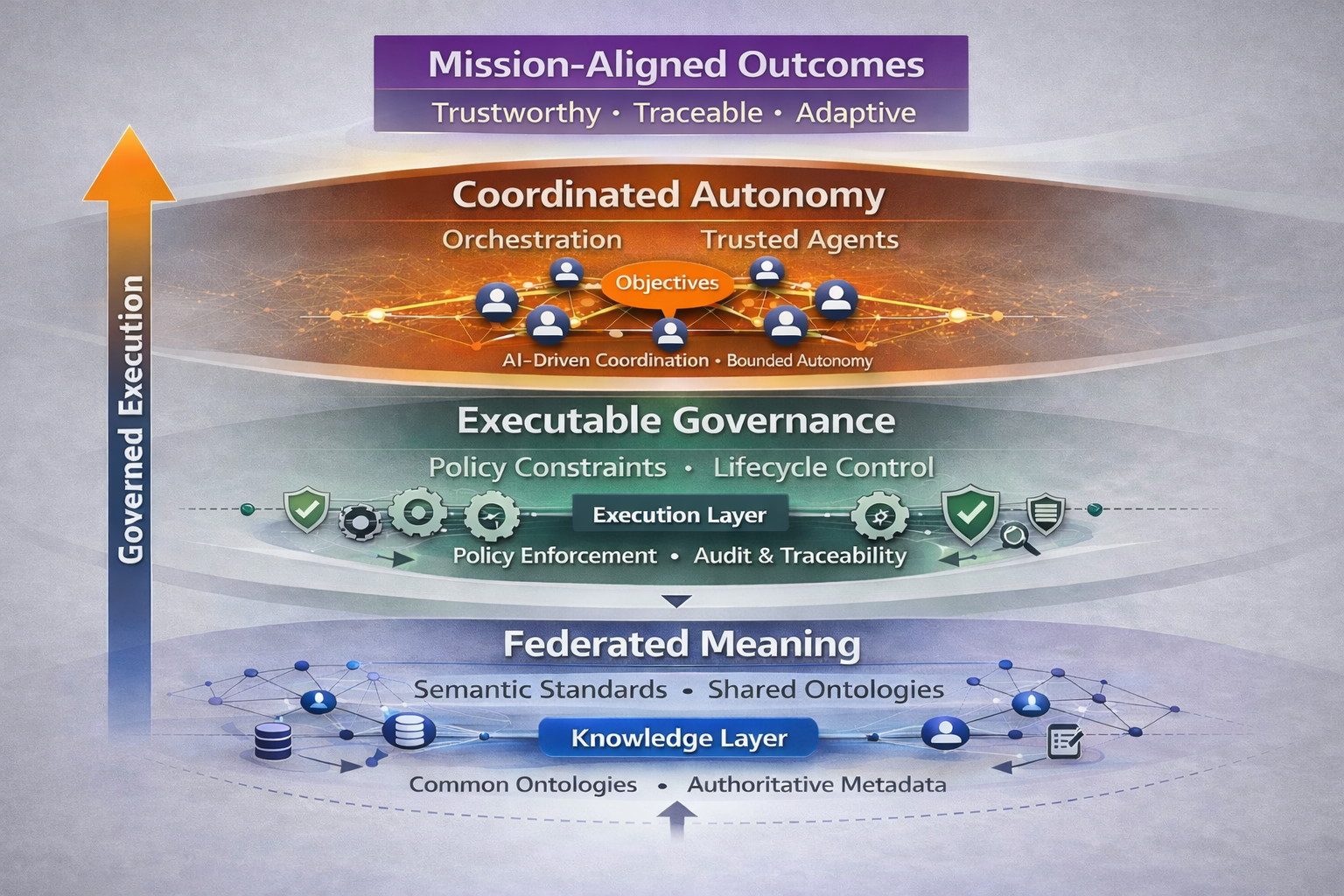
Operationalizing Federated Semantics: From shared meaning to executable governance to coordinated autonomy – an architectural progression that transforms interoperable data into mission-aligned outcomes.
When Meaning Becomes Infrastructure
In many distributed ecosystems, semantic drift is subtle but cumulative. Requirements evolve independently from models. Models diverge from configurations. Policies are interpreted differently across systems. Metadata exists, but it does not travel with authority or constraint. Over time, coherence degrades.
The IC DRA confronts this drift by insisting that meaning be explicit, computable, and shared.
KCEF implements that insistence through its Knowledge Layer: a distributed semantic substrate that treats meaning not as documentation, but as infrastructure.
In this layer, domain concepts are formalized. Identifiers are stable and decoupled from tool-specific keys. Relationships between entities, states, policies, and events are explicit rather than implied. Provenance is attached at the level of assertion, not after the fact.
For digital engineering programs, this is where digital thread integrity becomes structurally enforceable rather than aspirational. Configuration coherence is no longer dependent on disciplined process alone; it is grounded in shared semantic identity.
For mission environments, cross-domain coordination ceases to rely on naming conventions and institutional memory. It rests on machine-interpretable definitions that persist as systems evolve.
For industry, interoperability stops being a brittle mapping exercise and becomes a durable semantic contract.
The Knowledge Layer is the architectural realization of the IC DRA’s federated meaning foundation. It stabilizes what the enterprise means.
But stabilizing meaning does not yet stabilize action.
When Governance Becomes Executable
The IC DRA emphasizes lifecycle governance and computational enforcement. It acknowledges that federated domains require guardrails that travel with data.
KCEF extends this into operation through the Knowledge Execution Layer – the execution fabric.
If the Knowledge Layer ensures that systems share the same definitions, the Execution Layer ensures that actions respect those definitions under policy and authority constraints.
Here, governance moves from documentation to runtime enforcement. State transitions are validated before they occur. Authority boundaries are applied across domains. Constraints are evaluated deterministically. Every action carries provenance linking decision to outcome.
In a digital engineering environment, this means that change impact analysis can be computed rather than manually inferred. Configuration transitions can be policy-validated rather than assumed correct. Cross-tool traceability becomes structurally embedded in the architecture.
In mission contexts, it means cross-domain coordination occurs within defined authority limits. Escalation is triggered when thresholds are exceeded. Auditability is not reconstructed after the fact; it is captured as the system operates.
Governance is no longer something the organization tries to remember to enforce. It becomes a property of the system itself.
And once meaning and governance are both structural, something new becomes possible.
Coordinated Autonomy, Bounded by Design
Across DoD, IC, and industry, interest in agents and AI-assisted coordination is accelerating. Yet autonomy without structure simply amplifies drift. When systems reason over loosely defined concepts and implicit policy, coordination becomes improvisation.
KCEF’s orchestration layer does not invent context. It inherits it.
Because semantic identity is explicit and lifecycle constraints are executable, orchestration can operate over shared meaning rather than surface similarity. Objectives can be decomposed using formal domain definitions. Capabilities can be selected based on semantic compatibility. Constraints can be evaluated before actions are invoked.
This produces bounded autonomy: adaptive coordination operating within explicit semantic and authority limits.
In mission environments, this enables trustworthy cross-domain action under oversight requirements.
In digital engineering programs, it supports automated synchronization across requirements, models, configurations, and verification artifacts without sacrificing configuration control.
In industry, it enables safe automation across distributed business processes while preserving accountability.
Autonomy depends on governance.
When Architecture Changes, Interaction Changes
The most visible transformation occurs at the human interface.
In traditional transactional systems, users navigate applications one step at a time. They manually orchestrate across silos. They translate between domain vocabularies. They carry policy constraints in their heads.
When federated semantics and execution governance are in place, interaction rises to the level of intent.
Instead of stitching together transactions, users can express structured objectives:
Restore operational readiness within a defined time horizon.
Assess cross-domain risk exposure.
Synchronize configuration state across engineering baselines.
Evaluate supplier impact on mission capability.
The system decomposes. The architecture coordinates. The human governs authority and intent.
Goal-oriented experience is not a user interface innovation layered onto legacy systems. It is the visible consequence of operationalizing federated semantic governance.
A Pattern for Data-Rich Distributed Ecosystems
While the IC DRA provides a formal model for federated semantic interoperability within the Intelligence Community, the architectural pattern extends well beyond it.
Any organization operating in a data-rich, distributed ecosystem confronts the same structural challenge: how to coordinate action across independently evolving domains without sacrificing governance, authority, or auditability.
The progression is consistent:
Interoperable data enables shared meaning.
Shared meaning enables computational governance.
Computational governance enables bounded autonomy.
Bounded autonomy enables governed execution.
The IC DRA establishes the semantic and lifecycle foundation. KCEF operationalizes that foundation into coordinated, policy-bound action.
Federated meaning becomes executable governance.
Executable governance enables trustworthy coordination.
Trustworthy coordination produces mission-aligned outcomes.
And as data volumes expand and AI systems become increasingly capable, the differentiator will not be who can generate the most insight. It will be who can translate insight into coordinated action – safely, repeatably, and under explicit authority constraints.
Federated meaning is the foundation.
Governed execution is the advantage.
Trustworthy autonomy is the multiplier.
In complex, distributed ecosystems, architecture – not algorithms – will determine who succeeds.