
The Tipping Point for Knowledge-Governed AI
There is a growing recognition that LLMs alone do not deliver trustworthy autonomy at scale. The tipping point is an architectural shift: pairing AI with a reusable meaning layer and policy-governed execution so outcomes become reliable, repeatable, and defensible.
Most organizations are no longer asking whether AI works. They are asking whether AI can be trusted, scaled, and operated under real constraints, with real consequences. That is not a model question. It is an architecture question.
This post argues that the next evolution of enterprise AI is not “more prompts” but an engineered architecture: a semantic meaning layer, policy-aware orchestration, and a governed execution fabric that turns model outputs into accountable actions. When those layers exist, the user experience naturally rises from transactions to goal-oriented execution (GoUX).
This is the premise behind the Knowledge-Centric Engineering Framework (KCEF), and it is the lens through which enterprise AI adoption should be interpreted today.
Key Takeaways
AI adoption stalls when meaning is ambiguous, policy is implicit, and execution depends on brittle point integrations.
KCEF treats knowledge as an operational control plane: a shared meaning layer that normalizes entities, relationships, constraints, and provenance.
Governed autonomy becomes possible when orchestration and execution are policy-enforced, auditable, and designed to stop or escalate when conditions are not met.
Goal-oriented UX (GoUX) is an outcome of the architecture: users express intent, while the stack decomposes and executes within bounded authority.
A practical path exists: start with high-value inputs (e.g., data sources and services), formalize meaning and constraints, and scale by reuse – not by rebuilding.
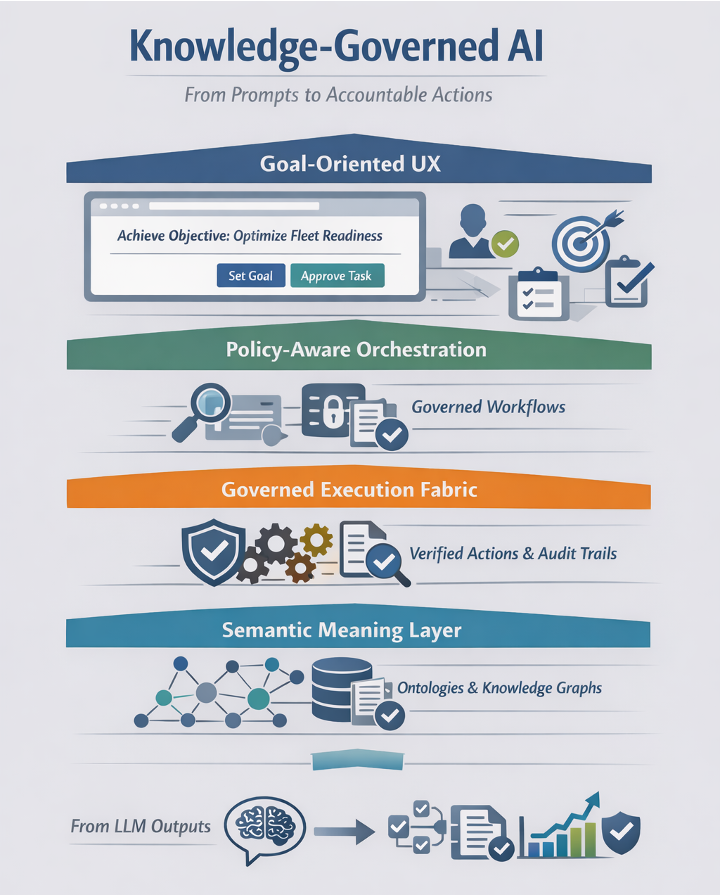
KCEF turns model outputs into accountable action by grounding intent in shared meaning, orchestrating work through policy, and executing with verification and auditability.
A refined hypothesis for modern AI adoption
The early research conclusion offered a refined hypothesis that is strikingly contemporary when mapped to today’s AI landscape:
Transition is gradual because enabling components mature at different rates
Early deployments deliver partial value that motivates further investment
Adoption appears linear until enough organizations connect their architectures and semantics
At a tipping point, adoption accelerates to a faster, non-linear pattern
Eventually, the capability becomes a commodity, or baseline expectation for interoperability and effectiveness.
What triggers the tipping point isn’t a single breakthrough model. It is the moment when:
knowledge becomes structurally reusable across teams and architectures,
controls become enforceable rather than aspirational,
and AI-driven workflows become composable and auditable enough to trust at scale.
This is precisely why a KCEF-aligned approach matters.
The real blocker: not intelligence, but operational throughput
The question is not whether AI will be used; it is whether we will keep bolting stochastic components onto brittle workflows, or re-architect the stack so autonomy is bounded, verifiable, and aligned to mission and business outcomes.
In modern terms: enterprises don’t struggle because AI can’t generate answers. They struggle because the organization can’t reliably turn information into decisions and actions, and fast enough, consistently enough, and safely enough.
The constraints show up in familiar forms
Delays created by fragmented sources and inconsistent terminology
Backlogs in analysis, review, or approvals
Noise and low signal-to-cost ratios in data collection
Uncertainty from ambiguous identity, provenance, and timeliness
Gaps between what architectures “know” and what workflows “need”
In other words, AI adoption is not merely about enhancing cognition. It’s about increasing the decision rate without sacrificing accuracy and doing so with clear accountability.
That is the adoption problem KCEF is designed to solve.
KCEF as the architecture that makes AI adoptable
KCEF can be understood as three reinforcing layers that convert AI potential into enterprise reality:
1) Knowledge Layer: meaning, constraints, provenance
This layer establishes a shared semantic foundation
Ontologies encode what things mean, how they relate, and what constraints apply.
Knowledge graphs encode authoritative state and relationships.
Evidence provides traceable support and citation paths.
Provenance and versioning make outputs reproducible and defensible.
Without this, AI outputs remain persuasive but fragile, difficult to verify, hard to govern, and expensive to scale.
2) Execution Fabric: governed action and operational discipline
This layer is what separates “assistant” from “capability”
verification gates (grounding, citations, redaction, confidence)
constrained action execution (allowlists, parameter bounds, approvals)
observability and audit trails (trace the full transaction)
resilience patterns (idempotency, retries, rollback/compensation)
This is where AI becomes safe to use and safe to scale.
3) Orchestration Layer: policy-aware composition
This final layer is where AI becomes operational
intent interpretation and entity resolution
policy-scoped retrieval (what the user is allowed to know, for what purpose)
tool selection and workflow composition
structured prompt/context assembly grounded in retrieved evidence
In modern architectures, orchestration is the control plane that turns raw model capability into repeatable, policy-governed behavior.
Goal-Oriented UX: the visible consequence of governed architecture
When KCEF stabilizes meaning and makes policy enforceable, the user experience can move beyond transactions. Goal-oriented UX turns open-ended prompts into structured objectives with explicit constraints, authority boundaries, and verification steps.
Instead of navigating tools and approvals, users state intended outcomes (e.g., “restore readiness within 72 hours”), and KCEF decomposes the goal, executes within policy, and reports progress with rationale and traceability. The human governs intent; the architecture orchestrates execution.
Why the tipping point depends on integration, trust, and transition guidance
What KCEF adds is an explicit operating architecture for trust: meaning is modeled, policy is enforced at decision time, and execution is monitored and audited end-to-end.
Integration is where value becomes real
Individual components can produce local improvements. But the “real power” shows up when they operate seamlessly in concert, knowledge, orchestration, and execution.
Enterprises feel this immediately
A retrieval architecture without governance increases risk
A model without evidence increases inconsistency
Automation without constrained execution increases blast radius
The tipping point requires an integrated architecture that turns partial wins into compounding advantage.
Trust and security are not add-ons
Trust is not a memo, and security is not a slide. They are engineered properties.
In a knowledge-grounded AI architecture, trust is produced through
provenance and evidence traceability,
policy enforcement at retrieval and execution time,
verification gates that can block or constrain outputs, and
auditability that stands up to scrutiny.
When trust is engineered, adoption scales because risk becomes manageable.
Transition guidance is the difference between theory and adoption
Enterprises don’t adopt architectures, they adopt paths. Transition guidance is about sequencing:
where to start for measurable value,
what to standardize first,
how to evolve governance and operating models,
and how to move from decision support to safe automation.
KCEF is most effective when paired with an adoption roadmap that makes progress visible and sustainable.
The modern takeaway: enterprise AI is a architectures transition, not a feature release
Today’s generative AI wave can mislead teams into thinking the hard part is choosing a model. In reality, models are increasingly abundant. What is scarce is the capacity to deploy AI as a governed, composable, operational capability.
Organizations that reach the tipping point first will do a few things consistently:
They treat meaning as infrastructure. They invest in shared semantics so workflows and data products compose cleanly across domains.
They operationalize governance. Policy is enforced by architectures, not by training or hope.
They standardize orchestration patterns. Retrieval, prompting, verification, and tool-use are reusable patterns with release gates, not one-off implementations.
They instrument everything. They treat AI like any production architecture: observe, measure, test, and improve.
They modernize the operating model. They align platform engineering, knowledge engineering, security/compliance, and domain leadership around shared accountability for outcomes.
That combination is what turns adoption from linear to non-linear.
Preparing for the tipping point
This aligns with earlier research and field experience: when meaning and policy are explicit and machine-interpretable, autonomy becomes an engineering property rather than a leap of faith.
AI adoption accelerates when enterprises stop treating AI as a model and start engineering it as a knowledge-governed architecture.
KCEF provides a contemporary blueprint for doing exactly that: establish a semantic foundation, orchestrate policy-aware workflows, and execute actions through a controlled, observable fabric.
The tipping point is coming; not because models get smarter, but because enterprises will increasingly be forced to interoperate, justify outcomes, and operate at speed. The winners will be those who build the knowledge and governance substrate that makes AI safe to trust, and safe to scale.
About Crown Point
Crown Point Technologies is a leader in leveraging standard ontologies to create powerful knowledge graphs, with extensive experience in the, aerospace, defense, and pharmaceutical industries.