
From Transactional Systems to Goal-Oriented Experience
Why user experience must (will) evolve in the age of governed autonomy
Across the last three articles, we have followed a deliberate progression.
We began with token overload: the recognition that simply adding more text to large language models does not produce clarity. Without shared semantics, systems reason over ambiguity. Context windows expand, retrieval pipelines multiply, but meaning remains unstable.
We then introduced knowledge-governed execution: the idea that ontologies and knowledge graphs provide the structural foundation required to stabilize meaning and encode policy. When knowledge is explicit and constraints are formalized, systems can move from probabilistic suggestion to bounded, reliable action.
Finally, we explored agent orchestration: demonstrating that autonomy only becomes trustworthy when agents operate inside that governed semantic fabric. Agents can decompose goals, select tools, and coordinate execution, but they must do so within shared meaning and explicit policy boundaries.
This brings us to the most visible transformation of all. (For a more detailed discussion of Goal-oriented UX, see From Transactional Systems to Goal-Oriented Experience.
If agents can act across systems within a knowledge-governed architecture through the Knowledge-Centric Engineering Framework (KCEF), then the user experience itself must change. The interface cannot remain transactional while the architecture beneath it becomes goal-driven.
The shift from transactional interaction to goal-oriented experience is not cosmetic. It is architectural.
The Burden of Orchestration (today)
Most enterprise and mission systems were built around transactions. Users are forced to:
Navigate application boundaries to accomplish one objective
Move data manually between tools
Reconcile terminology differences across systems
Infer constraints and approvals from experience, not from the system
Even with integrations, orchestration still falls on the human. We’ve normalized humans acting as middleware.
The shift is from humans orchestrating transactions to architecture orchestrating execution.
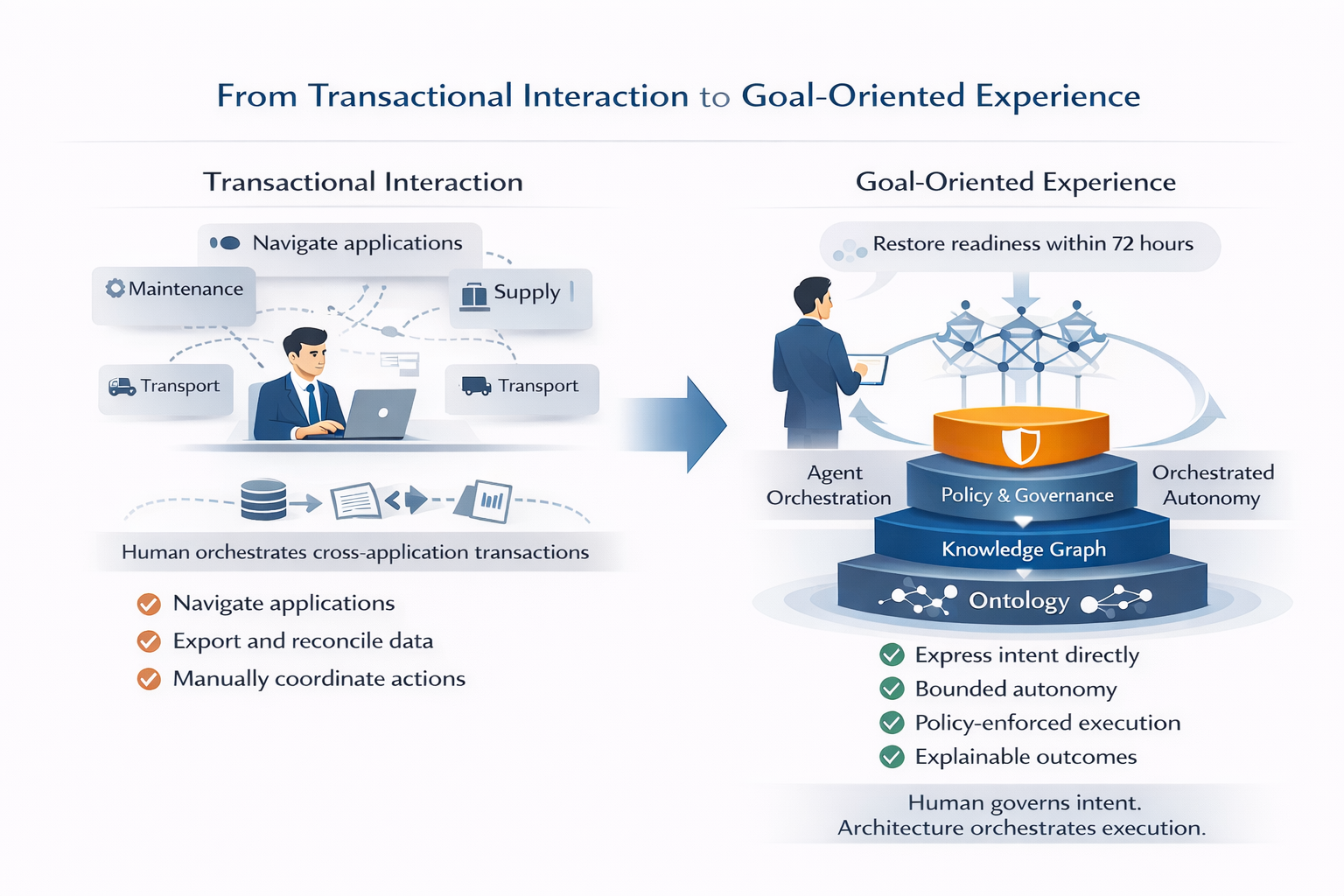
From Transactional Interaction to Goal-Oriented Experience: In transactional systems, humans orchestrate across applications. In goal-oriented UX on KCEF-style stacks, humans define intent while knowledge-governed orchestration coordinates execution within policy boundaries (bounded autonomy).
When the Architecture changes, Interaction changes
In KCEF, a shared semantic foundation stabilizes meaning and makes policy enforceable:
Ontologies harmonize definitions and constraints.
Knowledge graphs unify state, relationships, and provenance.
Policies become explicit, enforceable, and auditable.
Agents operate inside those boundaries to decompose goals and coordinate execution.
When that foundation exists, the UX naturally rises to the level of objectives.
Instead of asking:
Which system owns this data?
Which application has the function I need?
Who approves this action?
Users can express goals like:
Restore readiness within 72 hours
Assess risk across theaters
Identify vulnerabilities affecting this program
The system decomposes the goal across capabilities, executes within policy, and routes exceptions to humans.
The human governs. The architecture orchestrates.
The Executive Point
Goal-oriented UX is the visible consequence of governed architecture.
If meaning is unstable and policy is implicit, a “chat interface” just triggers brittle APIs. But when meaning is explicit, policy is embedded, and autonomy is bounded, transactional UX becomes the bottleneck.
Goal-oriented experience isn’t a feature enhancement.
It’s what emerges when systems are engineered for governed, outcome-driven execution.
Ready to move from transactions to outcomes?
KCEF provides the semantic foundation and governance model that makes goal-oriented UX trustworthy at scale.
For the deeper framework, patterns, and use cases, visit the Goal-Oriented UX page: From Transactional Systems to Goal-Oriented Experience
About Crown Point
Crown Point Technologies is a leader in leveraging standard ontologies to create powerful knowledge graphs, with extensive experience in the, aerospace, defense, and pharmaceutical industries.