
Multiagent Systems Will Scale … On a Distributed Semantic Substrate
Gartner is right to spotlight the rise of multiagent systems. As problems grow more complex and cross-domain, it is natural that we move from single reasoning engines to coordinated collections of agents. Decomposition, specialization, and collaboration are powerful architectural patterns.
But as multiagent systems move from proof-of-concept to production, an important question emerges:
What substrate allows agents to coordinate reliably across distributed enterprises?
Because the real scaling challenge is not agent count; it is semantic and governance coherence.
Beyond API Chaining
Many early multiagent implementations rely on patterns such as tool calling, API chaining, prompt routing, and sequential task delegation. These approaches are useful steppingstones. They demonstrate how agents can invoke capabilities dynamically. But they do not, by themselves, constitute scalable orchestration.
API chaining connects functions; it does not align meaning across domains.
Tool invocation executes actions; it does not enforce shared policy constraints.
Prompt-based delegation decomposes tasks, but it does not guarantee that agents interpret entities, identifiers, and authority boundaries consistently.
As environments become more distributed and policy-sensitive, these patterns accumulate fragility. Agents begin coordinating over loosely shared assumptions rather than explicit, governed meaning. The system works until ambiguity, sovereignty, or cross-domain constraints are stressed.
To scale multiagent systems responsibly, coordination must move from implicit to intentional.
The distinction becomes clearer when we compare procedural coordination patterns with architectural orchestration patterns. Both may involve multiple agents. But the structural foundations, and therefore the scalability characteristics, are fundamentally different.
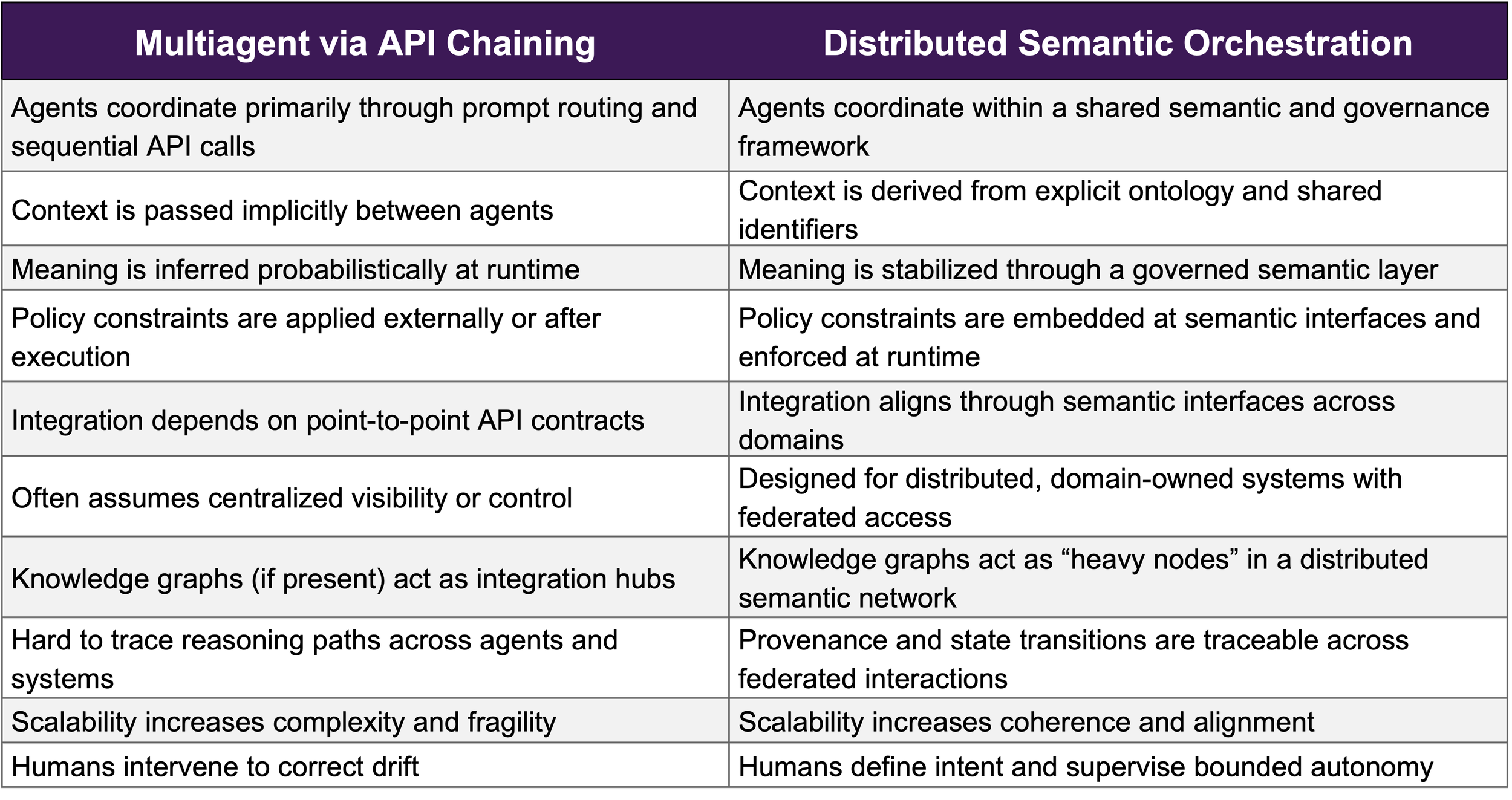
API chaining scales activity. Distributed semantic orchestration scales alignment, governance, and trust across distributed enterprise systems.
The difference is architectural, not cosmetic.
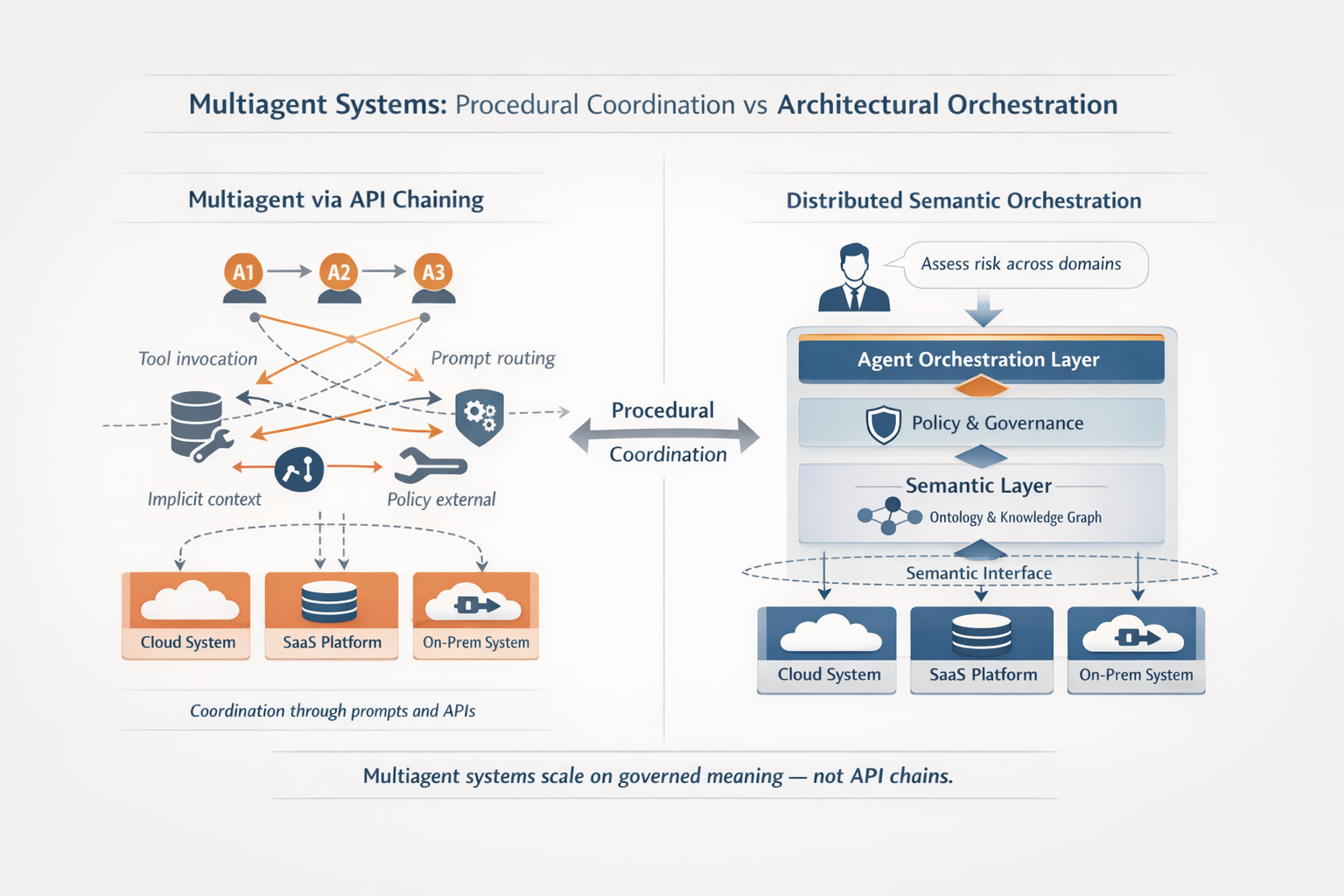
Procedural Coordination vs. Architectural Orchestration: Multiagent systems scale reliably only when agents operate within a distributed semantic substrate, where shared meaning, policy governance, and execution boundaries are intentionally aligned.
The illustration contrasts two fundamentally different approaches to multiagent coordination. On the left, agents are connected primarily through prompts and API calls. Context flows implicitly between systems, and governance is applied externally or after execution. This pattern can demonstrate capability, but as scale and policy complexity increase, coordination becomes fragile and difficult to audit.
On the right, agents operate within a distributed semantic architecture. A shared (distributed) ontology layer stabilizes meaning across domains. Policy is embedded at semantic interfaces and enforced at runtime. Execution occurs within authoritative systems, while orchestration coordinates goals across domains without centralizing control. Knowledge graphs function as “heavy nodes” in a broader semantic network, enabling federation rather than forced consolidation. The result is bounded autonomy – not improvisational automation – and a foundation that allows multiagent systems to scale with coherence rather than complexity.
The Distributed Enterprise Is the Default
Modern enterprises are inherently distributed:
Data spans clouds, SaaS platforms, operational systems, and partner ecosystems
Ownership and authority reside in domains
Sovereignty, latency, and mission constraints limit centralization
Policies differ by context and jurisdiction
Multiagent systems cannot assume a single, centralized knowledge repository. Nor should they. Instead, they must operate across a distributed semantic substrate — a web of actionable, governed data where meaning is made explicit at the interface between systems.
Meaning must travel, not storage.
Knowledge Graphs as Heavy Nodes
Leading enterprises have already deployed significant knowledge graph platforms. These deployments often act as powerful integration hubs that stabilize definitions, link entities, and improve analytics and AI grounding. But it is useful to view these not as monolithic centers, but as heavy nodes in a distributed semantic network.
Each heavy node:
Encodes domain-level ontology and relationships
Governs definitions and identifiers
Anchors policy enforcement and validation
Supports high-value analytics and AI use cases
Yet no single node contains the enterprise.
The future is not one global graph replacing all systems. It is a network of semantically aligned domains with each exposing governed, machine-understandable interfaces, and connected through federation and shared identity conventions.
Multiagent systems must operate across this web.
Multiagent Systems Need Shared Meaning, Not Shared Storage
True multiagent coordination requires:
Stable identifiers across domains
Explicit ontologies defining shared concepts
Policy and constraint models embedded at the interface
Federated query and reasoning patterns that compose context without forcing wholesale data movement
Agents reason over federated semantic views assembled from distributed systems. They decompose goals across domain boundaries. They respect local authority while aligning to shared definitions.
Coordination emerges not from passing messages alone, but from operating within a web of actionable, governed meaning.
Without this substrate, multiagent systems risk becoming distributed API chains. With it, they become distributed autonomy.
The Agent Triad as a Design Pattern
Multiagent discussions often focus on coordination mechanisms. But coordination alone does not produce reliable autonomy. The more foundational design pattern is what we have described as the Agent Triad:
Knowledge: explicit representation of entities, relationships, and state
Policy: defined constraints, authority boundaries, and validation rules
Execution: the ability to act within operational systems
An agent that reasons without governed knowledge improvises. An agent that acts without policy drifts. And an agent without execution is inert.
In distributed enterprises, the Triad must be implemented across domains. Knowledge is harmonized through shared ontologies and identifiers. Policy is enforced at semantic interfaces and runtime. Execution remains local to authoritative systems.
Multiagent systems scale only when each participating agent operates within this Triad, and when orchestration coordinates agents that share it.
Orchestration as an Architectural Layer
True agent orchestration is not merely task routing or tool invocation. It is the coordination of agents within:
A shared semantic framework
Explicit governance constraints
Federated knowledge access
Verifiable state transitions
In distributed environments, orchestration must decompose goals across systems without violating ownership boundaries. It must enforce policy at query and execution time. It must preserve provenance across domains. This requires a knowledge-centric execution fabric — an architectural separation between meaning, governance and execution.
Agents participate within this fabric. They do not replace it.
Anchoring to KCEF: From Meaning to Governed Autonomy
At Crown Point Technologies, we frame this progression through the Knowledge-Centric Engineering Framework (KCEF).
KCEF begins with an actionable meaning layer in which ontologies and knowledge graphs stabilize definitions and relationships across domains. It supports distributed semantic interfaces rather than forcing centralized storage. It leverages federation so context can be composed across systems while optimizing colocation.
Above that, KCEF introduces policy-aware orchestration which coordinates agents across this distributed semantic substrate while enforcing authority boundaries and risk constraints.
Finally, it operationalizes governed execution which embeds validation, constraint enforcement, observability, and auditability into runtime behavior.
In this model, multiagent systems are not loose networks of reasoning engines. They are participants in a distributed web of governed meaning.
Knowledge graphs act as heavy nodes supporting intensive algorithm and analytics processing.
Semantic interfaces connect domains across the distribute substrate.
Federation composes context for machine-actionable operations.
Orchestration coordinates action for scalable and coherent behaviors.
Policy bounds autonomy for trusted and secure outcomes.
This is how multiagent systems move from experimental coordination to production-grade, distributed autonomy.
The Strategic Opportunity
Multiagent systems are not just about smarter task delegation. They are about enabling coordinated, policy-aware behavior across distributed enterprises.
The organizations that succeed will recognize that:
API chaining is a starting point, not a strategy
Centralization is neither necessary nor scalable
Knowledge graphs are anchors, not silos
Meaning at the interface is infrastructure
Orchestration must be governed, not emergent.
Multiagent systems will scale. But they will scale on a distributed semantic substrate – a web of actionable, governed data that makes autonomy trustworthy across domains.